
Multichannel communication platform: social networks and email in one console
An influencer, a small business or an organization often juggles several accounts, several networks, emails and approvals, with too many scattered tools. We are designing a single console to create content once, choose channels, schedule, send email campaigns and track results. A working prototype, shown here with demonstration data.
- Client
- LBN Communications - produit en développement
- Year
- 2026
Our clients keep describing the same scene: a content creator managing Instagram, TikTok and YouTube from a phone, a small business whose Facebook page and newsletter are run by two different people, an organization preparing an announcement for its members that has to be published three times. Everyone opens several tools, copies the same text, forgets a network or an approval.
LBN Communications decided to design its own answer: a multichannel communication console, a product in development, whose working prototype is presented here with fictional data.
"Manage my social networks and my communications from one place." Behind that sentence, precise expectations:
- connect several accounts and several brands in one console;
- write a post once, choose the networks, attach visuals, publish or schedule;
- see a calendar of what was published and what is coming;
- send emails to a list (newsletter, announcement, reminder) without switching tools;
- have content approved by a manager before publication;
- know what was published, sent and opened.
Problem and pain points
Too many tools, too many repetitive operations. The same announcement is typed three or four times, with variants that drift apart. Visuals are scattered between a phone, a shared folder and messaging apps. Emails leave from another service, with another list and another template. On a Monday morning, nobody knows what has to go out this week or what is waiting for approval.
The result: forgotten posts, duplicates, wasted time, and communication that depends on one person's memory.
Challenges
- Network APIs. Meta (Facebook, Instagram), TikTok, X and Google (YouTube) each require app approval and per-account permissions: the console has to work before each connector is activated, and say honestly what is integrated and what is not.
- One piece of content, several formats. 280 characters here, a vertical video there, a link elsewhere: adapt without rewriting everything.
- Approval. An editor prepares, a manager approves, an administrator handles accounts: clear roles and a history.
- Email and networks together. A campaign can combine an email send with coordinated posts.
- Security. Encrypted authorization tokens, no network password stored, role-based access, activity log.
- Credibility. Never promise "publish everywhere in one click": each network's constraints are real.
Thinking and approach
We started with the central gesture: the universal composer. Create content once → choose channels → adapt if needed → schedule or publish → track. Everything else in the console is organized around that journey: the library feeds the composer, the calendar shows what it produces, the history keeps the trail, the reports measure.
Second choice: build a complete prototype with demonstration data first, with two fictional brands (a content creator, a small business), to validate the experience before activating connectors. Each network is shown with its real state - prepared, in development, planned - and posts to a non-integrated network stay queued.
Third choice: the same foundation as our other custom software (Laravel, Filament), to deliver quickly, secure by default and adapt the console to each organization.
Solution
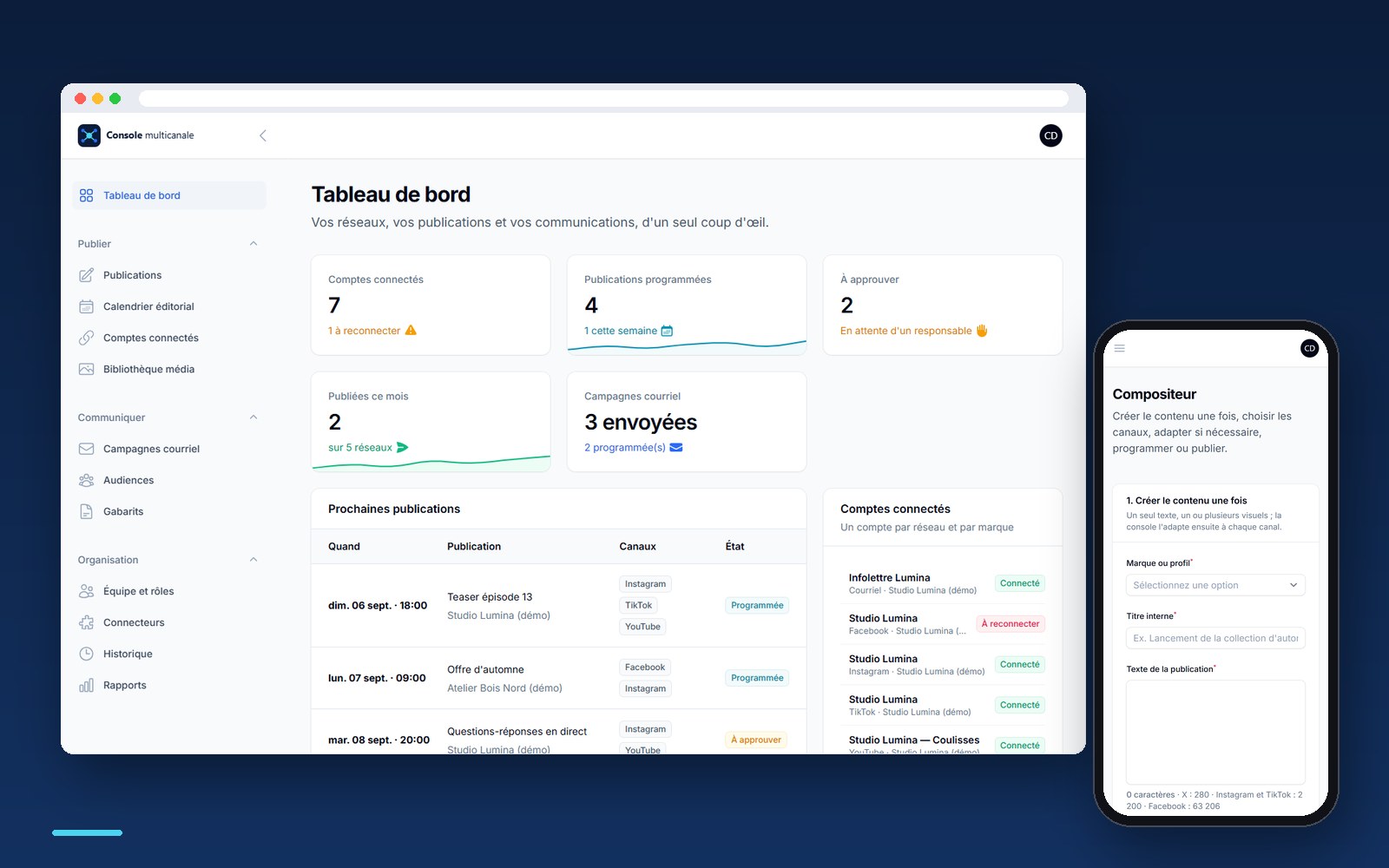
The multichannel console brings together, in a single interface, the accounts of several brands or profiles, posts, the editorial calendar, the media library, email campaigns with their audiences and templates, the team and its roles, the history and the reports. The dashboard shows at a glance the connected accounts, scheduled posts, what is waiting for approval and the campaigns sent.
The message is simple: social networks + email in one platform. The prototype works end to end (create, schedule, approve, publish, send a campaign, browse the history); real sends depend on connectors, activated one by one according to each organization's priorities.
What the solution makes possible.
-
Connected accounts
several brands or profiles, one account per network and per brand, connection status, reconnection.
-
Universal composer
one text, visuals, channels to tick, a preview, a short variant, draft, scheduling or immediate publication.
-
Publishing queue and approval
draft, pending, scheduled and published states; a manager approves before sending.
-
Editorial calendar
month by month, past and planned posts, filters by brand and network.
-
Media library
visuals and videos sorted by brand and tag, reusable in posts.
-
Email campaigns
audience, template, writing, scheduling, sending, history, open and click rates.
-
Audiences and templates
recipient lists and reusable emails (newsletter, announcement, offer).
-
Dashboard
accounts, upcoming posts, pending approvals, campaigns, recent activity, reconnection alerts.
-
Team and roles
administrator, editor, approver, read-only.
-
History
who created, approved, published, sent, and when.
-
Connectors
the real state of each integration, with no promise: prepared, in development, planned.
-
Reports
publishing volume, breakdown by network, email campaign results.
The solution in pictures.
Real screenshots taken on demonstration environments: no personal data. Tap an image to enlarge it.
-
Dashboard: connected accounts, scheduled posts, pending approvals, campaigns, upcoming posts (demo data) -
Universal composer: one text, character count per network, channels to tick, preview, scheduling -
Editorial calendar: past and planned posts, filters by brand and network -
Connected accounts: one account per network and brand, connection status, followers, reconnection -
Media library: visuals sorted by brand and tag (demo visuals) -
Email campaign: audience, template, writing, scheduling, results (simulated send) -
Connectors: the real state of each integration - prepared, in development, planned -
Reports: posts per week, breakdown by network, campaign opens and clicks -
On a phone: dashboard, composer and calendar (real prototype captures at 390 px)
How the client was supported.
For an organization adopting the console, support follows our usual approach: understand the channels actually used and who does what, configure brands, accounts, roles and templates, import recipient lists, train the team on the composer and the calendar, then activate connectors in order of priority.
The console can be adapted to influencers, creators, artists, brand managers and communication teams, as well as small businesses, organizations, companies and associations: the same gestures, with vocabulary and channels adjusted.
What the client gained.
- A working end-to-end prototype: dashboard, accounts, composer, approval queue, calendar, library, email campaigns, audiences, templates, team, connectors, history, reports.
- Two demonstration brands, nine accounts, fifteen posts, six campaigns, four roles: enough to test every journey without real data.
- A transparency principle applied in the interface: Facebook and Instagram prepared, TikTok, X and YouTube planned, email in development; no integration presented as operational.
- The same secure foundation as our custom software: role-based access, activity log, encrypted tokens designed in from the start.
Factual outcomes only; no unverified figures.
Next steps: activating connectors starting with Meta (Facebook, Instagram), real SMTP sending with open tracking, audience statistics per network, mobile apps to publish from a phone, and a multi-organization version to offer the console as a hosted service.
More of our work
See our work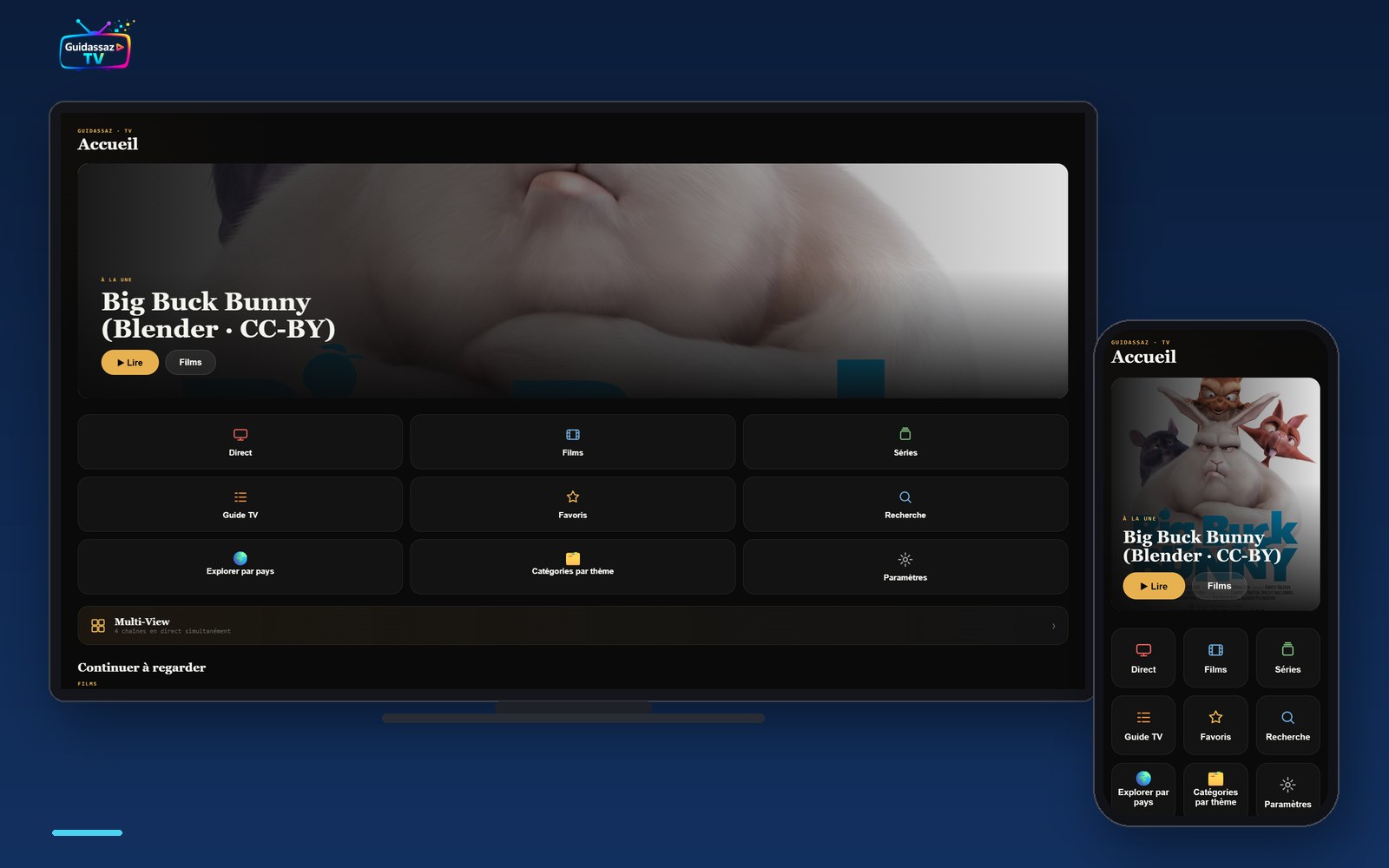
 Multi-platform application
Guidassaz TV: one media player for every screen in the home
Guidassaz wanted to give its users a single TV application, identical on Android TV, Fire TV, Samsung, LG, desktop and phone, with an account that follows each person from one screen to the next. We designed and built the application, its sync service and its administration console.
- Applications
- Custom software
 Custom management software
HCBE Canada software suite: a member portal and management cockpit for an association
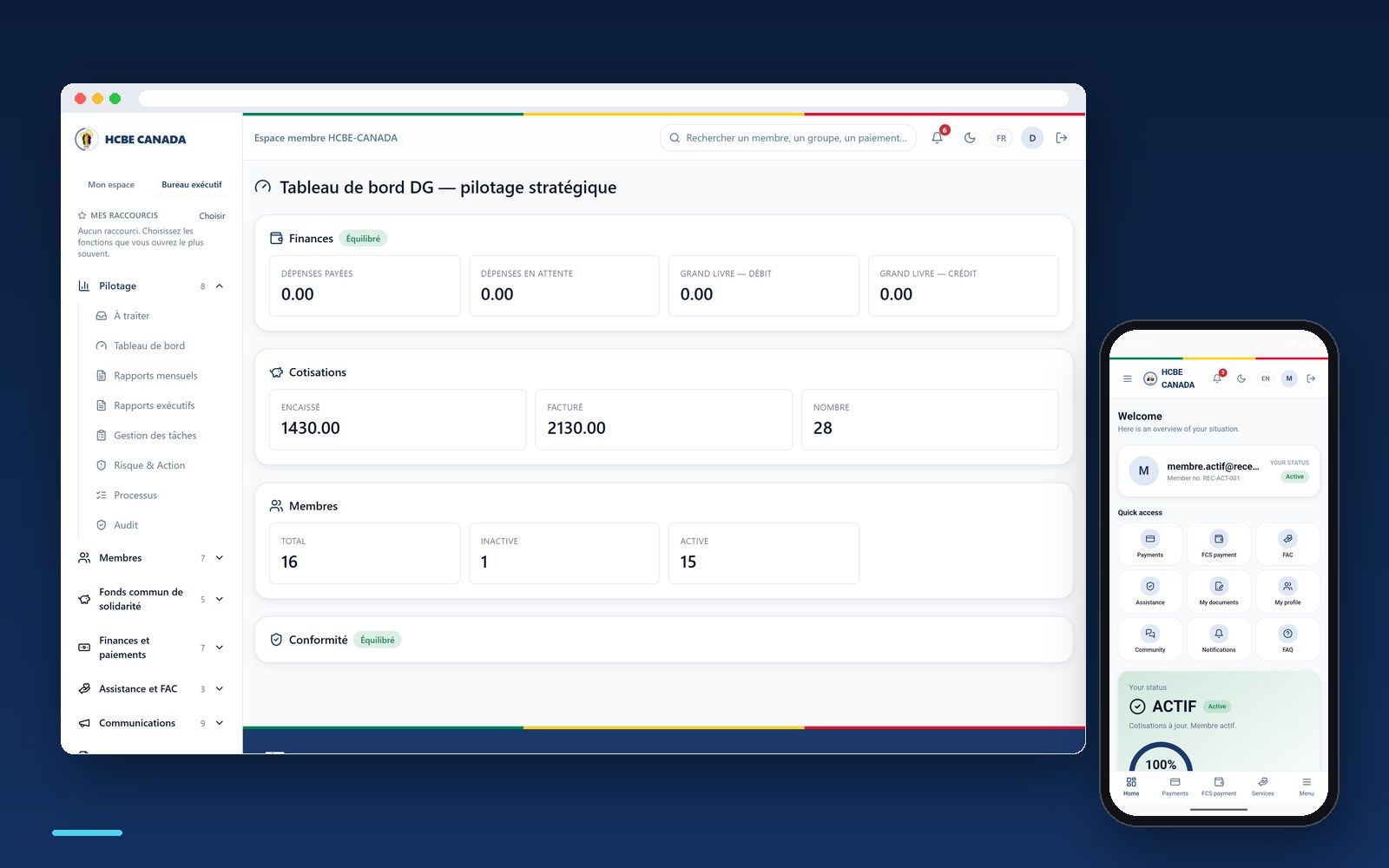
HCBE-Canada managed its members, dues and solidarity programs with spreadsheets, emails and bank transfers reconciled by hand. We designed a bilingual software suite: a clear member portal for everyone, a steering cockpit for the executive board, ten roles with strict permissions and an audit log compliant with Quebec's Law 25.
- Custom software
- CRM
- Management solutions
 Institutional website
HCBE Canada website: the front door to a community and its services
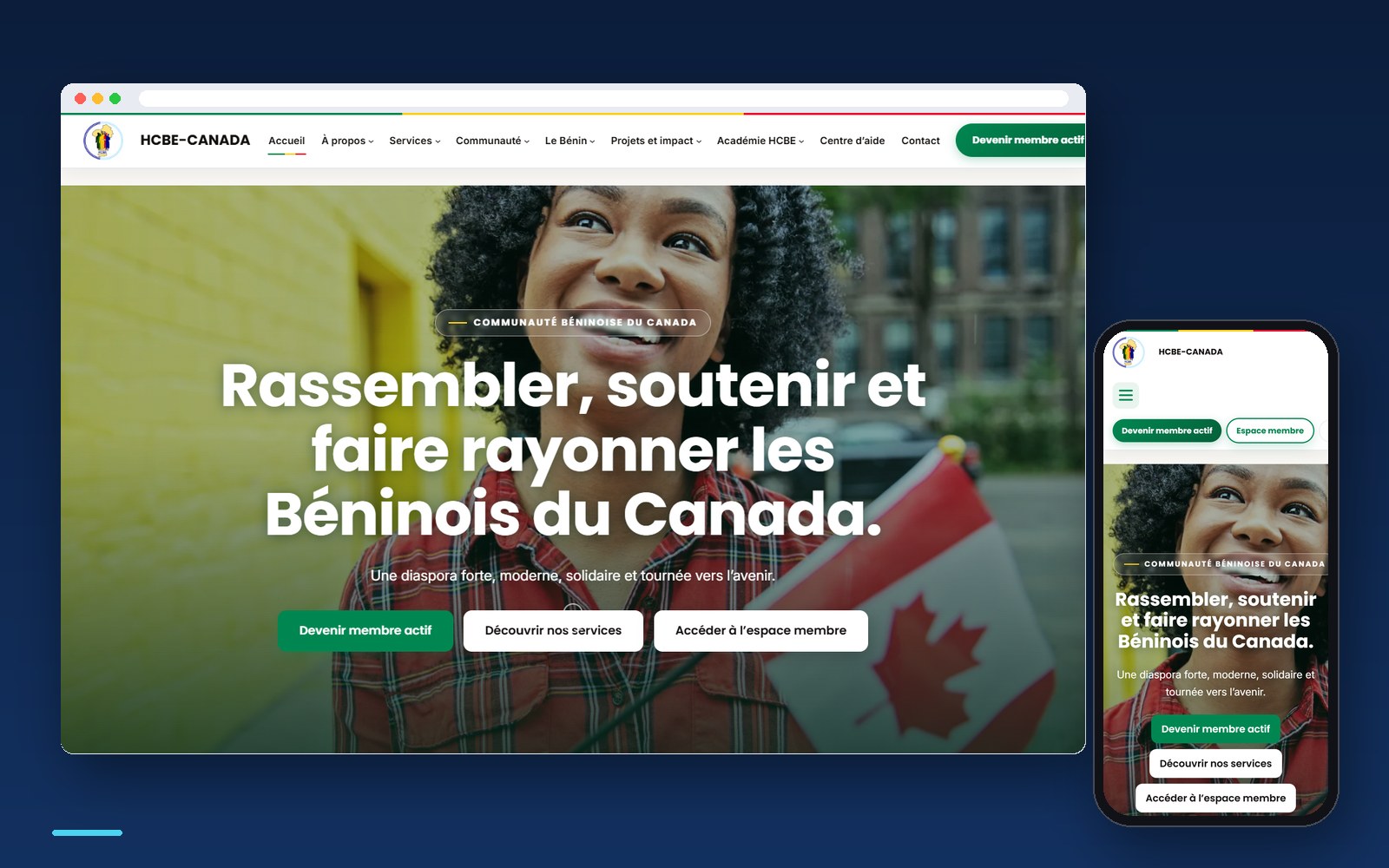
The HCBE-Canada website was an almost empty showcase: its solidarity services were invisible and nothing let a visitor become a member. We rebuilt the site from the ground up - eight-section architecture, custom theme, "Become a member" journey, strict separation between public content and sensitive data - and connected it to the secure member portal.
- Websites
- Client portals and areas
Have a similar project?
Every organization is different, but the pain points look alike. Tell us about yours.
Reply within two business days